
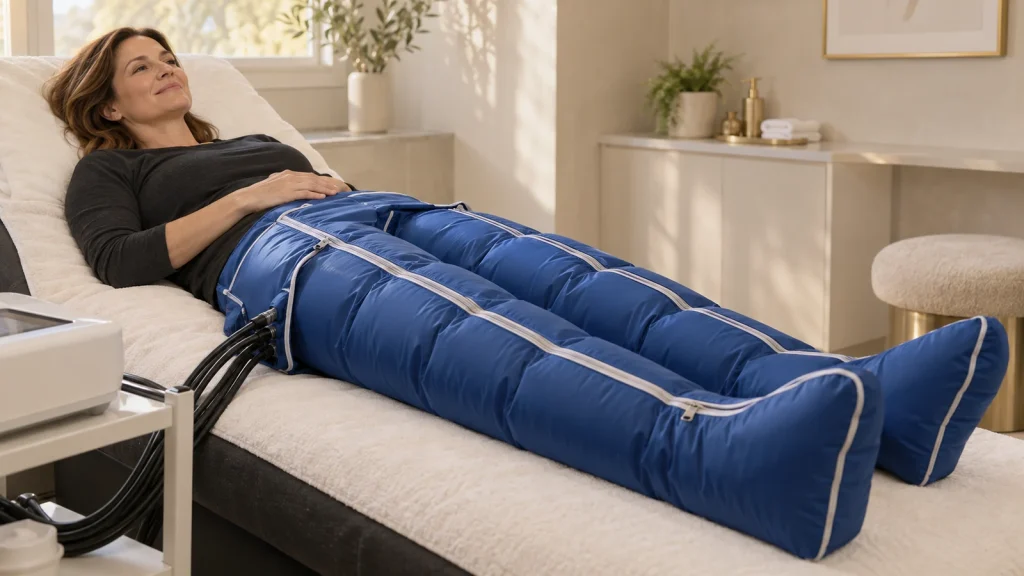
Lymphatic drainage uses a machine that squeezes your legs or arms in a steady rhythm, pushing fluid through your lymphatic system. After body contouring, we usually add it right after a cold treatment, because the treated fat cells leave your body by that route.
It moves fluid, so on its own it will not remove fat or change your shape.
What does your lymphatic system do?
Your lymphatic system collects extra fluid from your tissues and returns it to your bloodstream, according to Cleveland Clinic. Tiny vessels pick the fluid up. Larger ones then move it toward two big ducts in your upper chest.
The National Cancer Institute says the lymphatic system has no pump like the heart. Instead, fluid moves when your muscles work, when you breathe, and when the walls of the vessels tighten.
What does lymphatic drainage do?
Lymphatic drainage presses on your legs or arms from the outside, then lets go. That on and off pressure pushes fluid along the vessels, the way your body would if it had a pump.
Cleveland Clinic lists pneumatic compression pumps as a treatment for lymphedema. Lymphedema is swelling that happens when something affects the lymphatic system. These pumps fill and empty a sleeve in a regular cycle, so fluid does not build up in the arms and legs.
Why does lymphatic drainage come after a cold treatment?
When we treat an area with cold, some of the fat cells in it break down. Your body clears them out over the following weeks, so the change goes on after you leave.
A review of studies on cold fat treatments, published in the World Journal of Plastic Surgery in 2025, says immune cells digest the fat. That fat reaches the liver through the lymphatic system, 14 to 30 days after the treatment.
Because of that route, we usually put lymphatic drainage last, straight after the cold treatment. It supports a process your body already does, and we make no promise that it speeds up your result.
Our page on how CryoSculpting treats one area explains the cold side of a plan.
What does a lymphatic drainage session feel like?
Our machine is the BOA Max 2. Nobody works on you with their hands, so it is not a massage.
You lie down and put on what look like inflatable trousers or sleeves. They fill and release in a pattern, starting at the far end of your leg or arm and working in toward your body.
The feeling is a firm, rhythmic squeeze that moves up the limb and then lets go. A lot of people close their eyes for it.
There is no downtime, though you may need the bathroom afterwards.
Can you book lymphatic drainage on its own?
Yes. Plenty of people book it by itself, especially for swelling or for recovery after training. Some book it for heavy or tired legs, or for stiffness.
We are not a doctor’s office, and some swelling needs a doctor first.
When should you see a doctor about swelling first?
NHS guidance on swollen ankles, feet and legs lists signs that need an urgent doctor’s appointment, including these.
- You have swelling in one ankle, foot or leg, and you do not know the cause.
- It is severe or painful, or it started suddenly.
- The swollen area is red or feels hot to the touch.
If you are short of breath, or your chest feels tight, heavy or painful, call 911. Those signs could mean a blood clot in your lungs, the NHS says.
Coming in from around St. Louis
Our studio is on Old Olive Street Road in Creve Coeur, just off Olive at I-270, with parking right outside the door. Chesterfield, Ladue, Clayton and Town and Country are a short drive away.
Lymphatic drainage goes on the end of the same visit when you book it with a cold treatment.
We are open Monday to Thursday from 8:00 AM to 6:00 PM, and Friday from 8:00 AM to 4:00 PM.
What to do next
If a cold treatment is in your plan, ask about adding lymphatic drainage at the end of each session. For swelling or recovery after training, you can book it on its own.
Our page on lymphatic drainage in St. Louis covers what it helps with, how a session goes, and the questions people ask first.
Call (314) 301-9012, or book an intro visit. The intro visit takes about half an hour, and if lymphatic drainage is not the right fit for your goals, we will say so.